
Finding the right business management platform is essential for teams looking to streamline operations, improve collaboration, and boost productivity. Two prominent solutions in this space are Bitrix24 and Zoho—comprehensive platforms that offer customer relationship management (CRM), project management, and collaboration tools, but with distinct approaches and strengths.
Bitrix24 positions itself as an all-in-one workspace combining CRM, communication tools, task management, and website building in a single platform. It emphasizes unlimited users on its free plan and social collaboration features. Zoho provides a comprehensive suite of business applications with its CRM at the core, focusing on deep customization capabilities and extensive third-party integrations.
In this Bitrix24 vs Zoho article, we'll compare their features, usability, pricing, pros, and cons to help you understand how they differ, where they overlap, and which platform may be the better fit for your organization's needs.
Features | Bitrix24 | Zoho |
Analytics And Reporting | Sales funnel analytics, employee performance tracking, Sales Intelligence, BI reporting | Advanced analytics with data preparation, augmented analytics, data storytelling, unified business insights |
Tasks And Workflow Management | Workflow automation, automated funnels, task templates, Gantt charts, Kanban boards | Workflows, Blueprint, approval processes, cadences, assignment rules |
Ease Of Use And UI | Social intranet-style interface, activity streams, unified workspace | Modular approach, customizable layouts, Canvas for personalized experiences |
Sales Pipeline Management | Visual pipeline, CRM rules and triggers, lead scoring, repeat sales | Territory management, sales forecasting, CPQ, journey orchestration |
Billing And Invoicing | Estimates, invoices, payments, catalog, inventory, e-signature integration | Inventory management, built-in invoicing, purchase orders, vendor management |
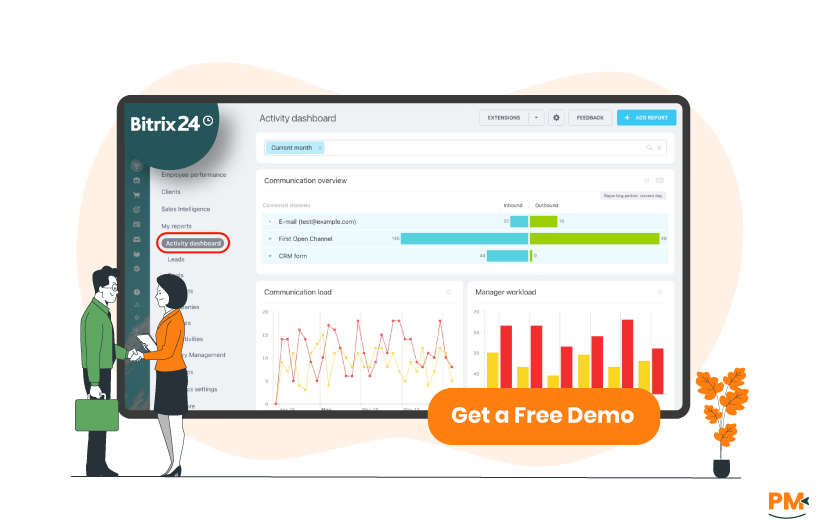
Bitrix24 is a unified collaboration platform that brings together 35+ sales and marketing tools under one roof. Known for its generous free plan supporting unlimited users, Bitrix24 combines CRM functionality with internal communication tools, project management, and website building capabilities.
The platform emphasizes social collaboration through activity streams, group chats, and video conferencing integrated directly into the CRM workflow. With features like chat, video calls, tasks, calendar, file storage, and online documents, it creates a comprehensive digital workplace where teams can manage customer relationships while maintaining internal collaboration.
Bitrix24 Pros and Cons
Pros | Cons |
|
|
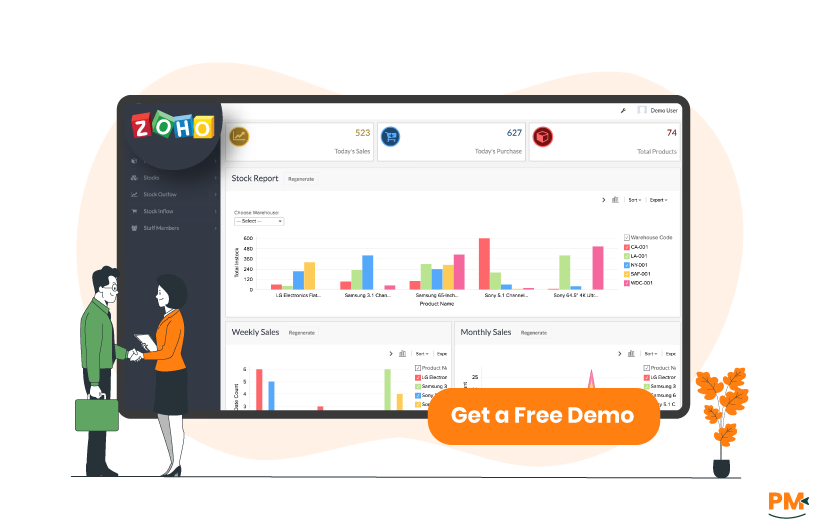
Zoho provides a comprehensive ecosystem of several integrated business applications with its CRM serving as the central hub for customer data and sales processes. The platform focuses on flexibility and customization, allowing businesses to tailor every aspect of their CRM experience.
The CRM includes advanced features like Zia AI assistant for sales forecasting and anomaly detection, multi-channel communication capabilities, and deep integration with the entire Zoho suite. With support for custom modules, page layouts, and validation rules , teams can build highly specialized workflows that match their unique business processes.
Zoho Pros And Cons
Pros | Cons |
|
|

Bitrix24
Bitrix24 provides analytics focused on sales performance and team productivity. The platform includes sales funnel analytics, employee performance tracking, and BI Builder dashboards that help managers understand pipeline health and team efficiency. Reports can be customized to track key metrics like conversion rates, deal velocity, and activity completion.
The system also offers real-time activity monitoring through its social collaboration features, allowing managers to see team engagement and project progress at a glance.
Zoho
Zoho delivers enterprise-grade analytics with advanced capabilities for data analysis and visualization. The platform features augmented analytics that auto-generates reports and dashboards, data preparation tools for merging datasets, and AI-powered report summarization.
With data storytelling capabilities and unified business insights, teams can create compelling presentations with infographics and share them through portals. The system supports complex data analysis with custom metrics and multi-dimensional reporting.

Bitrix24
Bitrix24 takes a collaborative approach to task management with features that integrate directly into the CRM workflow. Teams can use workflow automation and automated funnels to streamline repetitive processes, while task templates ensure consistency across projects.
The platform includes ‘Gantt charts’ for project planning, Kanban boards for visual task management, and time tracking capabilities. Tasks can be linked to CRM records, allowing teams to manage customer-related activities alongside internal projects.
Zoho
Zoho provides sophisticated workflow capabilities designed for complex business processes. The ‘ Blueprint’ feature guides sales reps through step-by-step processes, while cadences automate multichannel follow-up sequences.
The platform includes approval processes for accountability, assignment rules for automatic lead distribution, and validation rules to maintain data quality. Custom functions enable low-code automation across different applications in the tech stack.

Bitrix24
Bitrix24 features a social intranet-style interface that resembles familiar social media platforms. The activity stream provides a central hub for updates, while the unified workspace brings all tools together in one location. Navigation follows a module-based structure with quick access to frequently used features.
The platform includes customizable dashboards and widgets, though the extensive feature set can make the interface feel dense for new users. Mobile apps provide full functionality with an adapted interface for smaller screens.
Zoho
Zoho employs a modular design philosophy that allows users to customize their workspace extensively. The ‘Canvas’ feature enables teams to build personalized CRM experiences based on team needs and industry requirements.
The interface supports multiple page layouts within the same module, allowing different teams to see relevant information. The clean, professional design focuses on data visibility with customizable list views and detailed pages.

Bitrix24
Bitrix24 provides visual pipeline management with drag-and-drop functionality for moving deals between stages. The system includes CRM rules and triggers for automation, lead scoring to prioritize prospects, and repeat sales features for recurring business.
The platform supports multiple pipelines for different products or services, with customizable stages and fields. Integration with communication tools allows sales activities to happen directly within the CRM context.
Zoho
Zoho offers advanced sales management with territory management for geographic or vertical assignment, sophisticated sales forecasting with AI predictions, and configure, price, quote (CPQ) solution for complex quote generation.
The journey orchestration feature helps teams build end-to-end customer experiences, while SalesSignals provides real-time activity notifications. The system supports complex sales processes with multiple decision points and approval workflows.
Bitrix24
Bitrix24 includes integrated billing features within its CRM, offering estimates, invoices, payments, catalog management, and inventory tracking. The platform supports e-signature integration for contract management and automated invoice generation from deals.
Payment processing can be configured with various payment gateways, and the system tracks payment status within the CRM timeline. Product catalogs support multiple currencies and tax configurations.
Zoho
Zoho provides comprehensive financial management through its CRM with inventory management for products and services, integrated invoicing, and purchase order management. The platform handles vendor relationships alongside customer data.
The system supports complex pricing rules, discounts, and tax calculations. Integration with Zoho Books and other financial applications provides full accounting capabilities for businesses requiring detailed financial tracking.
Bitrix24 Pricing
Bitrix24 offers the following pricing plans:
- Free: $0/month (unlimited users)
- Basic: $61/organization/month (5 users)
- Standard: $124/organization/month (50 users)
- Professional: $249/organization/month (100 users)
- Enterprise: $499/organization/month (250 users)
The platform provides a 15-day free trial for paid plans without credit card requirement.
Disclaimer: Pricing is subject to change.
Zoho Pricing
Zoho Projects provides several pricing tiers:
- Free: $0/month (up to 3 users)
- Premium: $5/user/month
- Enterprise: $10/user/month
- Projects Plus: Custom pricing
The vendor offers a 15-day free trial for all paid plans with full feature access.
Disclaimer: Pricing is subject to change.
Bitrix24 is ideal for small to medium-sized businesses that need an all-in-one platform combining CRM with collaboration tools. Its unlimited user free plan makes it particularly attractive for startups and growing teams with limited budgets who need basic CRM functionality alongside communication features.
The platform performs best for teams between 5 - 100 employees who value integrated communication, social collaboration features, and prefer having all business tools in one place. Organizations that prioritize internal collaboration alongside customer management will find strong value in the unified workspace approach.
Companies in service industries, digital agencies, and remote teams benefit from the integrated video conferencing, task management, and document collaboration features that support both internal operations and client interactions.
Who Is Zoho Best For?
Zoho is best suited for businesses requiring extensive customization and scalability in their CRM solution. Its modular architecture and deep customization capabilities make it ideal for enterprises and growing businesses with complex sales processes or industry-specific requirements.
The platform excels for organizations with 10-1000+ users who need advanced features like territory management, multi-channel marketing automation, and AI-powered analytics. Companies already using other Zoho applications will benefit from seamless integration across the suite.
Industries with complex sales cycles, such as manufacturing, real estate, and B2B services, find particular value in Zoho's workflow automation, approval processes, and custom module capabilities.
Which One May Suit Your Needs Better?
Choosing between Bitrix24 and Zoho depends on your organization's priorities and technical requirements. Bitrix24 is designed for teams seeking an integrated workspace that combines CRM with collaboration tools in a social, user-friendly environment. It enables unified communication and project management alongside customer relationship management.
Zoho, by contrast, focuses on providing a highly customizable CRM platform with enterprise-grade features and extensive integration capabilities. With advanced AI features, complex workflow automation, and deep customization options, it suits businesses with sophisticated sales processes and specific industry requirements.
Many organizations find value in evaluating both platforms through their free plans—Bitrix24's unlimited user free tier for testing team collaboration, and Zoho's 3-user free plan for exploring customization capabilities. The integration between platforms is also possible through third-party tools for organizations wanting to leverage specific strengths of each.
Ultimately, Bitrix24 is the stronger choice for teams prioritizing all-in-one collaboration with integrated CRM, while Zoho better serves organizations requiring advanced CRM customization with enterprise features and AI capabilities.
What Are The Alternatives?
While Bitrix24 and Zoho are comprehensive business platforms, some teams may prefer alternatives based on specific feature requirements, industry focus, or budget constraints. Below are recommended alternatives for each.
Bitrix24 Alternatives
- Monday CRM - Visual project management platform with CRM capabilities and extensive automation
- Odoo - Open-source ERP system with integrated CRM and business applications
- HubSpot Operations Hub - Inbound marketing-focused CRM with strong content management features
- Pipedrive - Sales-focused CRM with visual pipeline management and activity tracking
Zoho Alternatives
- Apptivo - Offers integrated CRM + project management + invoicing; many apps/modules; customizable workflows
- Striven - All-in-one business management covers project management, CRM, accounting, inventory etc. Meant for SMBs
- SugarCRM - Open-source CRM platform with flexible deployment options
- Productive - Real-time profitability, project scheduling & task management, expense/time tracking, good for agencies
Both Bitrix24 and Zoho bring unique strengths to modern business management—Bitrix24 excels in unified collaboration with integrated project management capabilities, while Zoho thrives in customization and enterprise-grade features. The right choice depends on whether your priority lies in creating an all-in-one digital workplace, building highly customized sales processes, or combining elements of both through strategic implementation. By carefully evaluating your team's size, technical capabilities, and growth trajectory, you can choose the platform, or combination, that best supports productivity and sustainable business growth.